

Tim Hartford, former economist at Royal Dutch/Shell, current Financial Times economics columnist, and author of The Undercover Economist, is touring North America. He will be in Chicago tomorrow, in D.C. on Monday, and in Toronto on Tuesday. See the tour schedule for times and venues.
Tim Hartford in Chicago Tomorrow
Posted by erweinstein on February 1, 2007
Posted in Economics | Comments Off on Tim Hartford in Chicago Tomorrow
Happy Milton Friedman Day!
Posted by erweinstein on January 29, 2007
From Terry Savage at the Chicago Sun-Times:
Today has been declared Milton Friedman Day, and he will be honored today at the University of Chicago Rockefeller Chapel at 2 p.m., a ceremony that will be open to the public, and is co-sponsored by the University of Chicago and the Chicago Mercantile Exchange.
If you want to know more about his formidable influence, you can watch his biography, “The Power of Choice” on PBS tonight.
For more info, see http://www.miltonfriedmanday.org/
Here is a special feature from the website of The Economist.
Economist Arnold Kling has a commemorative essay here.
Posted in Economics, Politics | Comments Off on Happy Milton Friedman Day!
The Merging
Posted by erweinstein on January 29, 2007
Hello friends, well-wishers, and random internets people! With the impending discontinuation of the group blog of which I am a member (www.mankindminusone.com), I have decided that I wanted an individual blog to serve as a clearinghouse for the various things I write on the Internet. I also wanted to repost some of my older pieces that were lost during a server crash, and merge various posts of links and articles that I made on social networking sites. If my Mankind Minus One colleagues can engineer some other collaborative venue for expression, I will probably join it and this blog will remain secondary (make no mistake—I am extremely grateful to Max and Zach for their efforts, and I am sorry that MKM1 didn’t work out better for all of us). However, if I do not join another group project, expect this site to transition over the next year into a full blog, in the style of a quasi-daily (or weekly when workload is heavy) journal on the topics listed above, with the occasional post of random musings.
More content and hopefully some design changes will appear over the next few weeks.
Posted in Announcements, Personal | 1 Comment »
Is DRM on its way out?
Posted by erweinstein on January 22, 2007
Record labels rethink digital rights management at Midem – International Herald Tribune
We may be witnessing the start of a new era in the music business. More comments will follow if anything actually comes of this.
UPDATE: Steve Jobs endorses ending DRM. Don Dodge, one of the founders of Napster, explains Jobs’ reasoning and points out that Bill Gates agrees.
Posted in Music, Technology | 1 Comment »
In Memoriam: Milton Friedman
Posted by erweinstein on November 19, 2006
Milton Friedman, internationally-renowned advocate for personal and economic freedom, Nobel Laureate in Economic Sciences in 1976, and Professor Emeritus of Economics at the University of Chicago died in the morning of Thursday, November 16.
Thursday was a sombre day for many of us here at the University of Chicago. The University flags were lowered to half-mast, and professors in the Department of Economics and the Graduate School of Business were frequently recognizable by their downcast stares and more formal comportment and attire. Kevin Murphy (winner of the John Bates Clark Medal in 1997 as well as a MacArthur “genius grant” last year) who famously wears a baseball cap and sneakers every day, changed to a black cap and nicer shoes. According to his students, Gary Becker (Nobel Laureate 1992) who was a doctoral student of Friedman’s, was particularly distraught. Becker reflects on Friedman’s intellectual contributions here on his blog.
A panel discussion to commemorate Friedman’s achievements, featuring Becker, Robert Lucas, Sam Peltzman, and Eugene Fama, was held in the afternoon of Friday, November 17. Video of the discussion is now available.
Here are news stories about Friedman’s death from Reuters, The Economist, and the Chicago Maroon.
Economists Austan Goolsbee, Brad DeLong, Thomas Sowell, and Greg Mankiw have written excellent essays about Friedman. Milton’s son David Friedman wrote this poem on his father’s death.
Milton Friedman’s substantial contributions to economics and economic policy are adequately covered by the above links. It is illustrative that his developments in the areas of consumer theory, statistics, and monetary theory and history are widely used and taught today, with some updates to account for more data and more sophisticated mathematical techniques. However, I believe it worthwhile to highlight Friedman’s thoughts on the nature of classical liberalism. Before I even picked up his book Capitalism and Freedom, I realized that my views on politics and society were closer to Friedman’s than to any other contemporary public intellectual. The following passage from that book demonstrates Friedman’s deep understanding of classical liberalism and his dedication to human freedom:
As it developed in the late eighteenth and early nineteenth centuries, the intellectual movement that went under the name liberalism emphasized freedom as the ultimate goal and the individual as the ultimate entity in the society. It supported laissez faire at home as a means of reducing the role of the state in economic affairs and thereby enlarging the role of the individual; it supported free trade abroad as a means of linking the nations together peacefully and democratically. In political matters, it supported the development of representative government and of parliamentary institutions, reduction in the arbitrary power of the state, and protection of the civil freedoms of individuals.
Beginning in the late nineteenth century, and especially after 1930 in the United States, the term liberalism came to be associated with a very different emphasis, particularly in economic policy. It came to be associated with a readiness to rely primarily on the state rather than on private voluntary arrangements to achieve objectives regarded as desirable. The catchwords became welfare and equality rather than freedom. The nineteenth century liberal regarded an extension of freedom as the most effective way to promote welfare and equality; the twentieth century liberal regards welfare and equality as either prerequisites of or alternatives to freedom. In the name of welfare and equality, the twentieth-century liberal has come to favor a revival of the very policies of state intervention and paternalism against which classical liberalism fought. In the very act of turning the clock back to seventeenth-century mercantalism, he is fond of castigating true liberals as reactionary!
The change in the meaning attached to the term liberalism is more striking in economic matters than in political. The twentieth-century liberal, like the nineteenth-century liberal, favors parliamentary institutions, representative government, civil rights, and so on. Yet even in political matters, there is a notable difference. Jealous of liberty, and hence fearful of centralized power, whether in governmental or private hands, the nineteenth-century liberal favored political decentralization. Committed to action and confident of the beneficence of power so long as it is in the hands of a government ostensibly controlled by the electorate, the twentieth-century liberal favors centralized government. He will resolve any doubt about where power should be located in favor of the state instead of the city, of the federal government instead of the state, and of a world organization instead of a national government.
Because of the corruption of the term liberalism, the views that formerly went under that name are now often labeled conservatism. But this is not a satisfactory alternative. The nineteenth-century liberal was a radical, both in the etymological sense of going to the root of the matter, and in the political sense of favoring major changes in social institutions. So too must be his modern heir. We do not wish to conserve the state interventions that have interfered so greatly with our freedom, though, of course, we do wish to conserve those that have promoted it. Moreover, in practice, the term conservatism has come to cover so wide a range of views, and views so incompatible with one another, that we shall no doubt see the growth of hyphenated designations, such as libertarian-conservative and aristocratic-conservative.
Partly because of my reluctance to surrender the term to proponents of measures that would destroy liberty, partly because I cannot find a better alternative, I shall resolve these difficulties by using the world liberalism in its original sense—as the doctrines pertaining to a free man.
Written almost forty-five years ago, these words have yet to be equaled as a constructive and comparative explanation of classical liberalism (although Hayek’s “Why I Am Not a Conservative”, the postscript to The Constitution of Liberty, is also quite insightful—Hayek focuses more on the contrasts between classical liberals and conservatives, but his prose is more difficult by today’s standards).
The death of Milton Friedman diminishes the community of economists, political thinkers, and classical liberals. We may take some comfort from the fact that his work will undeniably live on.
UPDATE: A memorial service for Milton Friedman was held in Rockefeller Chapel at the University of Chicago on Monday, January 29.
Posted in Economics, Politics | 1 Comment »
Quite a Surprise
Posted by erweinstein on May 27, 2006
Paul Simon’s newest album, entitled Surprise, was released Tuesday, May 9. His first major studio release in six years, the album features ten new songs plus the previously-released “Father and Daughter” from the Wild Thornberries Movie soundtrack. (“Father and Daughter” was nominated for the Academy Award for Best Original Song in 2002, but lost to Eminem’s “Lose Yourself”.) Simon, who helped pioneer the singer-songwriter and worldmusic traditions in American popular music, integrates synthesizer and electronic effects into his new tracks with the help of Brian Eno, who co-produced the album. Eno co-wrote three of the new songs and lends his distinctive electronic style throughout. Amazingly (but not unexpectedly) the combination works, and the result is clever, interesting, fun, and—typically for Simon—profound. After my initial listening, I particularly like the songs “How Can You Live in the Northeast”, which mocks/observes the way we bicker about geographical, political, and religious differences, and the smooth and soulful ”Wartime Prayers”, in which Simon comments on how humans react to adversity, expresses dismay at the state of spiritual discourse in the post-9/11 world, and admits (somewhat self-referentially) that he doesn’t have all the answers.
It is hard to believe that the man who sang “I started to think too much when I was twelve / going on thirteen” (on the album Hears and Bones in 1983) and had a top 50 hit (with Art Garfunkel) when he was still in high school is now 64. Although his range is somewhat reduced, he compensates for it well, in part by adding half-spoken lyrics and more complex instrumentals.
Posted in Music | Comments Off on Quite a Surprise
Salman Rushdie: Talk Show Host?
Posted by erweinstein on May 26, 2006
Apparently, TV journalist Charlie Rose became ill in late March and was forced to undergo open-heart surgery. During his recovery, his interview show has been hosted twice (on April 27 and May 12) by Salman Rushdie. Yes, that Salman Rushdie, the notoriously reclusive author whose controversial novel The Satanic Verses has brought him death threats, as well as a fatwa by the late Ayotolla Khomeini calling for his assassination. Rushdie is known for ducking even loyal fans and allies, mannerisms that have been parodied on an episode of Seinfeld in which Kramer believes he saw Rushdie in the sauna. Rushdie and Rose became friends after Rushdie appeared on Rose’s program in the mid-1990s, so Rushdie volunteered to be a guest host when he learned that Rose was having surgery.
The episodes of the Charlie Rose Show hosted by Rushdie are available on Google Video here and here. The interviews are interesting (particularly the May 12 show) but I find the novelty of Salman Rushdie as a talk show host to be fascinating (as well as amusing and/or unsettling) in its own right.
Posted in Arts and literature | Comments Off on Salman Rushdie: Talk Show Host?
J.S. Mill Bicentennial
Posted by erweinstein on May 20, 2006
Today, May 20, marks the 200th anniversary of the birth of John Stuart Mill. I’m sure that I don’t need to extol the greatness of Mill to this audience, but we should all take the opportunity to learn more about the philosophical inspiration for Mankind Minus One [the now-defunct group blog to which I previously contributed].
In honor of the occasion, Catallarchy has a series of essays on Mill. Roger Scruton, willfully disregarding the history of economic and political thought, attacks Mill in this op-ed, as he believes that Mill’s defense of minority rights and opposition to senseless traditions paved the way for the greatest excess of the sham “liberalism” of the Twentieth Century. Andrew Sullivan offers a terse and insightful response here. Finally, at the Library of Economics and Liberty, Professors David M. Levy and Sandra J. Peart have written essays discussing the leading role of Mill and other classical economists in the British antislavery and anti-racism movements.
Posted in Economics, Politics | Comments Off on J.S. Mill Bicentennial
Israeli Elections 2006
Posted by erweinstein on March 29, 2006
On Tuesday March 28, the citizens of Israel voted in what was arguably one of the most important general elections in the nation’s history. With a record low voter turnout, the centrist Kadima Party secured a plurality with 28 of the 120 seats in the Knesset (Israeli parliament). Kadima, led by Acting Prime Minister Ehud Olmert, was widely expected to win, but its base of support has narrowed sharply over the past few months. Kadima founder and then-Prime Minister Ariel Sharon was incapacitated by a massive stroke on January 4 and remains in a coma, and while Olmert initially maintained and exceeded Sharon’s poll numbers, Kadima’s popularity has fallen since then. Despite their victory, Tuesday’s results were particularly disappointing for Olmert and his allies, as voter-intent polls in January showed Kadima winning over 40 Knesset seats, and polls from earlier this week suggested that Kadima would win 34 seats.
The Israeli Labor Party, under its new leader Amir Peretz, earned 20 Knesset seats. The Likud Party, Labor’s traditional rival and Israel’s largest party before its former leader Sharon broke away to found Kadima in November, won only 11 seats. Former Prime Minister Benjamin Netanyahu, who masterminded the internal Likud rebellion that forced Sharon and others in favor of the continued removal of Jewish settlers from Palestinian lands to leave the party, had the dubious distinction of leading Likud to the worst showing in party history. The religious (Orthodox Jewish) Shas Party won 13 Knesset seats and Israel Beiteinu, a socially conservative party whose support has traditionally been limited to Jews of Russian ancestry, won 12 seats. Surprisingly, a the Gil (Pensioners) Party, which has little political ideology except increased spending on senior citizens, won 7 seats.
Posted in Politics | Comments Off on Israeli Elections 2006
Fall of a Titan
Posted by erweinstein on January 4, 2006
On Wednesday night, Israeli Prime Minister Ariel Sharon suffered severe cerebral hemorrhaging. At Jerusalem’s Hadassah Ein Kerem Hospital, Sharon was placed under general anesthesia, and he underwent a six-hour life-threatening operation, as well as a follow-up operation Thursday morning, to stop the bleeding. These procedures appear to have been successful, but doctors are keeping Sharon in an induced coma. Sharon’s vital signs are stable, but he has experienced brain damage, the amount of which cannot be verified until he is conscious.
Professor Shlomo Mor-Yosef, the hospital’s director, has refuted rumors that Sharon is dead, and has pointed out that Sharon’s pupils are responding to light, suggesting that some (perhaps much) brain function remains.
Upon Sharon’s anesthetization, his governmental powers were transfered to Finance Minister Ehud Olmert, who will serve as Interim Prime Minister of Israel, possibly until Israel’s March 28 election. Sharon had a minor stroke on December 18 (apparently caused by a congenital heart defect), and he had been scheduled to undergo heart surgery today to prevent further such strokes. He had planned to temporarily transfer power to Olmert and return to work following the surgery, but it is now uncertain if Sharon will ever be physically and mentally capable of serving in public office again.
Posted in Politics | Comments Off on Fall of a Titan
Ben Bernanke nominated to replace Greenspan
Posted by erweinstein on October 24, 2005
President Bush has nominated Ben Bernanke to replace Alan Greenspan as the Chairman of the Federal Reserve Board of Governors. Bernanke is the Chairman of the White House’s Council of Economic Advisers and a former member of the Fed Board of Governors. He is considered to be one of America’s foremost monetary theorists, surpassed only by Greenspan and Greenspan’s predecessor Paul Volcker.
After the farce that is the Harriet Miers nomination, Americans of all political stripes should be breathing a collective sigh of relief. While his personal party affiliation is Republican (as was Greenspan’s before his nomination to the Fed), Bernanke is an academic economist, not a political operator, and it is highly unlikely that he would risk the nation’s economic stability for short-term political gain. Bernanke also has stronger credentials in matters of monetary policy than the others rumored to be on the president’s list to succeed Greenspan. For example, R. Glenn Hubbard, a Columbia professor and former Council of Economic Advisers Chairman, is an expert in the field of corporate finance, but he is less distinguished in monetary matters than Bernanke. If confirmed, Bernanke is likely to broadly continue Greenspan’s policy choices. Two important differences, which can be inferred from his time as a Fed governor, are that Bernanke possesses a greater understanding of the symbolic (i.e., media) importance of the Fed Chairman, and that he has a desire to increase the amount of debate and dissent during Fed meetings. As many people consider the Fed Chairman to be the second most powerful person in the US government, the ability to avoid media frenzy and the willingness to address criticism are qualities that should serve Bernanke very well.
UPDATE: This post, at its original home of www.mankindminusone.com, was cited by the Blogpulse Newswire.
Posted in Economics, Politics | 1 Comment »
Proof is the bottom line for everyone
Posted by erweinstein on October 5, 2005
I have a confession: I haven’t seen ‘Serenity’ yet. I’ll get to it, I promise. But at the University of Chicago, everyone is excited about the movie ‘Proof’. In case you haven’t heard, it’s about an earth-shatteringly brilliant but mentally ill University of Chicago mathematician (Anthony Hopkins), who in his final years is cared for by his daughter (Gweyneth Paltrow), herself a would-be mathematical theorist. The title has multiple meanings, but one of them refers to the discovery of what may or may not be an extremely important mathematical proof, completed by the Hopkins character during a period of mental clarity. On Tuesday night, I saw a special screening of ‘Proof’ at the campus cinema. The theater was packed to capacity, and the management actually delayed the start of the film by fifteen minutes so they could fill the last few seats. In addition to being set at the University of Chicago, the exterior shots were actually filmed in Chicago. Because it was the home-town crowd, there was some unnecessary but expected cheering upon viewing familiar locations or hearing some of the characters’ particularly Chicago-centric banter (including the obligatory potshots at Northwestern). However, the movie was excellent. In addition to agreeing with Roger Ebert’s four-star review, I have my own comments and analysis.
Posted in Arts and literature, Mathematics, Religion, Science | 1 Comment »
The IRA Disarms
Posted by erweinstein on September 26, 2005
I have to admit that I was skeptical when the Irish Republican Army announced on July 28 that its leaders had “formally ordered an end to the armed campaign” and instructed its military units to “dump arms”. While the Northern Ireland peace process sounded like it was on the right track, this declaration was hard to take at face value given that only seven months earlier, the IRA was implicated in a massive bank robbery. However, as the BBC reports, the independent committee overseeing the disarmament announced today that the IRA has completed its weapons decommissioning..
This important step cannot even begin to redress the tragic history of violence, repression, and recrimination in Northern Ireland. Protestant voters in Northern Ireland have made it clear that they will not simply trust the IRA to be on its best behavior. The rise of the Reverend Ian Paisley as the Unionist leader demonstrates that the Protestants are unwilling to continue to cooperate with the IRA and its political wing Sinn Fein without receiving something substantial in return. Unionists are right to be concerned that the IRA has not eliminated all of its military capabilities (the IRA destroyed the arms that it has stockpiled over the years, much of it purchased from the Libyan government, but IRA members can still construct improvised explosives or purchase new weapons). However, the IRA and Sinn Fein should be commended for taking a large step in the direction of peace. With luck, the disarmament of the (comparatively smaller) Unionist military outfits will follow later this autumn. Regardless of one’s sympathies regarding this contentious issue, everyone should be striving for a day when the question of Northern Ireland’s status can be resolved without the use of paramilitary groups. As British Prime Minister Tony Blair said in response to the disarmament report,
Today may be the day that peace replaced war, that politics replaced terror, on the island of Ireland. It is what we have striven for and worked for throughout the eight years since the Good Friday Agreement. It creates the circumstances in which the institutions can be revived.
Perhaps Blair is a little overly optimistic, but hopefully, he is not too far off the mark.
Posted in Politics | Comments Off on The IRA Disarms
The Quills Awards
Posted by erweinstein on September 12, 2005
As I was reminded by Stephen Dubner at the Freakonomics Blog, online voting is almost over for this year’s Quills Awards. A concise and impartial explanation of the awards from the Boston Globe can be found here. Voting ends at 11:59 PM EST on September 15. Vote here.
For some reason, the overall “popular” literary crop seems somewhat lackluster this year. However, “popular” books that fascinated me (and that earned my vote in their respective categories) include 1776, The Plot Against America, Harry Potter and the Half-Blood Prince, and Freakonomics. Whether you agree with me or think I’m crazy, there’s still time to let the folks at the Quills Literary Society and NBC Universal know what you think.
Posted in Arts and literature | Comments Off on The Quills Awards
Conservatives for Daley
Posted by erweinstein on September 12, 2005
I have great respect for Richard M. Daley, the Mayor of Chicago, unless and until he is directly linked to criminal activity. In contrast, I don’t like Senator Dick Durbin (D-IL, and House Minority Whip). His voting record is extremely partisan, even for a party leader. Durbin’s predecessor, the late Senator Paul Simon (not to be confused with the musician Paul Simon), had pronounced libertarian leanings and immense political courage to back up the often-strident leftist positions he took. While Durbin never misses an opportunity to oppose “Republican” ideas such as tax reform, Simon made an effort to learn about and even intelligently debate flat taxes and value-added taxes. Durbin just takes the party line and shoots down ideas like these; unlike Simon, it’s actually his job to intimidate Democratic senators who are willing to cross party lines for the benefit of the American people. I won’t discuss Durbin’s comments on the Senate floor comparing US soldiers to some of the Twentieth Century’s most heinous mass-murderers, and his subsequent apology, except to raise two small points: 1) As my friend Max brought to my attention, Daley had a large role in persuading Durbin to apologize. 2) No one knows better than Daley that Illinois is scandal-ridden enough and doesn’t need to be the center of nationally rancorous issues such as Durbin’s comments.
Posted in Politics | 1 Comment »
Hurricane “Price Gouging”
Posted by erweinstein on September 4, 2005
I have heard references on both CNN and Fox News to the “price gouging” that occurred before and after the disaster of Hurricane Katrina. The Office of the Attorney General of Florida has issued notices reminding citizens that price gouging is illegal and that suspicions of price gouging should be reported via the state hotline.
However prevalent it may be, the common understanding of “price gouging” is inaccurate because it ignores the principles of economics. “Price gouging”, is an emotionally charged term for a process that, unless it involves fraud, is essential to the national well-being. Two articles written in response to last years devastating Florida hurricanes, one by journalist David M. Brown and the other by world-renowned economist Thomas Sowell, explain the popular misconception.
Posted in Economics, Politics | Comments Off on Hurricane “Price Gouging”
Remembering Leonard Bernstein
Posted by erweinstein on August 25, 2005
Leonard Bernstein, composer, conductor, and colossus of American music was born eighty-seven years ago today. In the nearly fifteen years since his death, Bernstein’s star has fallen somewhat from its stratospheric heights. In Classical Music in America: A History of its Rise and Fall, Joseph Horowitz offers a compelling explanation of Bernstein’s career. The tragedy of Leonard Bernstein, as Horowitz depicts it, is that despite his many successes, Bernstein failed to live up to his artistic promise. Instead of becoming the facilitator of a genuinely American tradition in classical music, Bernstein became, in Horowitz’s words, an “artist upstaged by his own celebrity.” Bernstein’s legacy, Horowitz suggests, was not a revolution in American music characterized by Bernstein finding the holy grail of “[an American] Mozart”, but “the damaged hopes of this most American of classical musicians.” Although I have been a fan of Bernstein for as long as I can remember, Horowitz has convinced me that, in part, Bernstein did “fail” to reach his potential.
However, I would like to suggest that we remember Leonard Bernstein not only by questioning whether or not he lived up to his artistic potential, but also by celebrating his many musical triumphs. Although he only composed three symphonies (Jeremiah, The Age of Anxiety, and Kaddish), all three are well-crafted and powerful works that dispel the lingering idea that classical music (particularly the more traditional tonal variety) “ran out of steam” or “broke down” in the Twentieth Century. As the musical director of the New York Philharmonic from 1958 to 1970, Bernstein conducted and recorded unparalleled performances of his fellow American composers Aaron Copland (Appalachian Spring, “Fanfare for the Common Man”) and George Gershwin (“Rhapsody in Blue”, “An American in Paris”). Bernstein’s most popular composition was the music of West Side Story, a Broadway hit and later a movie that won 10 Academy Awards, including Best Picture. Many people (myself included) sometimes forget that Bernstein also composed the moving original music from the movie On the Waterfront, which won 8 Academy Awards including Best Picture and Best Director for Elia Kazan. Even Bernstein’s lesser-known works are vibrant and unique, such as the jazzy “New York, New York” and “Times Square: 1944” from the musical On the Town, the rousing Overture from the operetta Candide (an unparalleled work of lyrical, musical, and philosophical satire, which Bernstein co-wrote based on Voltaire’s work of the same name), and the uplifting Chichester Psalms, which is a choral treatment of Psalms 100, 108, 2, 23, 131, and 133 (all in Hebrew).
There is a difference between being denigrated for failing to achieve more, and having the quality of one’s existing accomplishments impugned. Although the critics and scholars have grown harsher towards Leonard Bernstein since his death (and not without reason), there should be no question that during his life, Bernstein made impressive recordings and wrote inspiring music. For anyone seeking to acquire the best of Bernstein’s composing and conducting, I agree with NPR Classical Music Commentator Ted Libbey’s recommendation of Sony Classical’s Bernstein Century series of re-released recordings. If you don’t mind opera, try the original cast recording of Candide.
Bernstein himself said, “To achieve great things, two things are needed: a plan, and not quite enough time.” Throughout his frantic, eccentric, and highly prolific career, Bernstein greatly enriched mankind through his music. Even if he did not achieve as much as he might have, Leonard Bernstein’s legacy contains more than enough to inspire and enlighten musicians and music-lovers, and to affirm that there are great American composers.
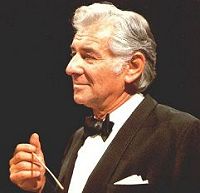
Here’s to you, Lenny!
Posted in Music | 1 Comment »
The Genius of Roger Ebert
Posted by erweinstein on June 23, 2005
I read Roger Ebert’s movie reviews every week. I read the reviews of many movies that I never intend to see, because there are many movie reviewers, but only one Ebert. His formidable writing skills never cease to impress me, whether he is feeling spiritual or vindictive. In addition to his superbly-styled prose, his movie recommendations and his understanding of Hollywood and modern American culture are unequaled.
If anyone needs additional testament as to the genius of Roger Ebert, read his review of Deuce Bigalow: European Gigolo.
Now, for the purposes of comparison (and to prove that he is not mean-spirited), read his review of a good movie, such as Raging Bull or Dr. Strangelove.
The man truly deserves his star on the Hollywood Walk of Fame.
Posted in Arts and literature | 2 Comments »
 Chicago, Athens, and Jerusalem